

Comparing Alberta and Newfoundland and Labrador's Response to Childhood Obesity
- Oct 31, 2023
- 4 min read
Updated: Dec 3, 2023
This week I teamed up with Danielle Coady (@CoadyDanielle) to examine how different provinces address childhood obesity. It was enlightening to see the different community and organizational measures in place and how they are influencing health in future generations.
Introduction

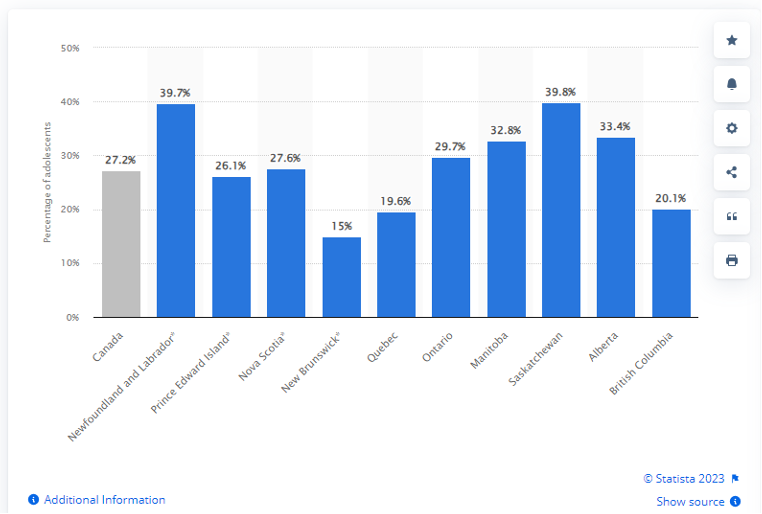
Childhood obesity rates have almost tripled in Canada in the past 30 years (GoC, 2023). As of 2023, 30% of Canadian children between 2-17 years old are classified as being overweight or obese (GoC, 2023). The three provinces with the highest rates are Saskatchewan (39.8%), Newfoundland and Labrador (39.7%), and Alberta (33.4%) (Elflein, 2022). Interestingly, the number of children in Alberta who are classified as overweight has been declining, yet the obesity rates remain stagnant since the 1970’s. Meanwhile in Newfoundland and Labrador, there has been a steady increase in overweight and obesity rates (GoC, 2023). As childhood obesity is a major risk factor for adult obesity and chronic illnesses such as Type II diabetes and joint disease, understanding the underlying causes can help mitigate and prevent onset of disease (GoC, 2015). Despite significant geographical and cultural differences between Alberta and Newfoundland and Labrador, comparing their community and organizational spheres of influence can provide insight to promote healthy child lifestyles throughout the country.
Alberta
In Alberta some leading contributors of childhood obesity include insufficient activity levels, over-reliance on vehicular transportation, poor nutrition, and increased screen time (GoC, 2015; PHAC, 2023). This is particularly apparent with the distribution of the obese population being more prevalent in rural communities. This has been linked with climate factors such as long, cold, dark winters limiting safe access to outdoor living. Fortunately, Alberta boasts some of the most affordable food in Canada. This is often supplemented with game meat and hunting practices, with 13% of Albertans identifying as hunters and consuming game meat (RR&C, 2015). However, supply chain and transportation costs can inflate the price of perishables such as fresh fruits and vegetables. This creates a financial barrier for those from low socioeconomic statuses as families struggle between providing nutritious foods and supporting a healthy active lifestyle on limited resources (CTV News, 2023; Nowicka, et. al., 2022; Shields, M. 2008). As a result, Alberta governments and agencies tackle childhood obesity rates from a proactive state by focusing on individual education and opportunity, and upstream systemic policies to improve community outlook and access to supportive services (AHS, 2023; DON SCN, 2017).
Newfoundland and Labrador
Meanwhile despite having a very different climate and cultures, Newfoundland and Labrador similarly faces inflated child obesity levels, coming in at the highest levels in Canada in 2021. Again, leading community factors include inactive lifestyles and poor diets with high fat and sugar content. Similarly, transportation is car-focused, with walking and biking being less common, especially in rural communities with large distances between destinations (CDC News, 2019). As an island, Newfoundland and Labrador also faces the unique challenge of importing many nutritious foods such as lean meats, fruits, and vegetables. This is not only a financial burden for the province, but a struggle for the population as weather and transportation delays can mean poor quality perishables. As a result, many families (especially lower income) focus their purchases on reliable, less healthy choices to fit their budget. As can be expected, childhood obesity is rampant in Newfoundland and Labrador, and the province has implemented several initiatives to prevent its spread.
Sphere of Influence | Alberta | Newfoundland and Labrador |
|---|---|---|
Community Level | · Grants are available to promote neighbourhood extracurricular activities such as sports programs or after school care programs focusing on healthy lifestyle · Subsidies are in place at a community and family level to offset costs of food · Resources are available to encourage healthy vending machines in child-centered institutions · Community gardens promote community engagement and healthy nutritional relationships. These can be privately or publicly funded through grants | · Charitable funding programs to help children from challenging backgrounds participate in organized sports · Education system has program where teachers include 20 mins of curriculum-linked activity per day in the classroom · Funding to support community projects, programs, and initiatives to increase physical activity and increase fruit and vegetable consumption · Programming to introduce children to traditional and non-traditional activities to increase physical activity and fun |
Organization Level | · Focuses on early detection and intervention for childhood obesity · Dietitian services are often used by pediatricians and can be paid for through private or public services · Education is provided to primary caregivers to standardize measurements, growth charts, and intervention pathways to ensure consistent classification of obesity | · Physical Activity Tax Credit incentive ($2000 per family) to help families access recreational activities and sports · 20 cent per litre sugar-sweetened beverage tax implemented to help decrease future demands on the healthcare system · Kids Eat Smart Foundation supports education, health, and wellbeing through nutrition |
Obesity Prevention Incentives
Alberta and Newfoundland and Labrador both have high rates of childhood obesity and incentives in prevention. Both provide education, programming, and funding and grants towards sports, extracurricular activities, and healthy eating, focusing on providing accessible resources to lower income demographics and supporting education. In the chart below (figure 1), obesity prevention strategies on community and organizational levels have been outlined from both provinces for comparison.
To connect with Danielle visit her on LinkedIn profile www.linkedin.com/in/danielleancoady
References
Alberta Health Services (2023). Obesity: Primary Health Care Resource Centre. Obesity Canada and Alberta Health Services. https://www.albertahealthservices.ca/info/Page7468.aspx
CBC News (2019). Expert weighs in as N.L. tops country for most overweight kids. Expert weighs in as N.L. tops country for most overweight kids | CBC News
CTV News (2023). Canada’s Obesity Rate has doubled since the 1970’s. What Happened? https://globalnews.ca/news/4456664/obesity-in-canada/
Diabetes, Obesity and Nutrition Strategic Clinic Network (2017). A Look at Childhood Obesity. Alberta Health Services. https://www.albertahealthservices.ca/assets/about/scn/ahs-scn-don-childhood-obesity-facts.pdf
Elflein, J. (2022). Share of Canadian adolescents who were overweight or obese in 2021, by province. Statista. Adolescents overweight and obesity by province Canada 2021 | Statista
Elflein, J. (2023). Percentage of Canadian adults who were obese in 2021, by province. Statista. Most obese province in Canada 2021 | Statista
Government of Canada (2015). Being Active. https://www.canada.ca/en/public-health/services/being-active.html
Government of Canada (2023). Childhood Obesity.Public Health Agency of Canada. ISBN: 978-0-660-29294-4. https://www.canada.ca/en/public-health/services/publications/science-research-data/inequalities-obesity-infographic.html
Government of Newfoundland and Labrador Health and Community Services. Programs and Initiatives. Programs and Initiatives - Health and Community Services (gov.nl.ca)
Government of Newfoundland and Labrador. Budget 2021: Promoting a Healthier Newfoundland and Labrador. Promoting a Healthier Newfoundland and Labrador - Budget 2021 (gov.nl.ca)
Government of Newfoundland and Labrador. Finance: Population stood at 538,605 as of July 1, 2023. https://www.gov.nl.ca/fin/economics/eb-population/
Nowicka, P., Ek, A., Grafström, E., Johansson, T., Nordin, K., Neuman, N., Reijs Richards, H., & Eli, K. (2022). How Do Interpersonal Relationships Affect Children’s Weight Management? A Qualitative Analysis of Parents’ Long-Term Perceptions after Obesity Treatment. Childhood Obesity, 18(4), 274–280. https://doi.org/10.1089/chi.2021.0156
Research Resolutions & Consulting Ltd. Ontario (2014). North American Hunters in Northern Ontario (RT013): A Situation Analysis. Tourism Northern Ontario. https://destinationnorthernontario.ca/wp-content/uploads/2018/09/RTO13-Hunting-Report-Final-Feb-2010.pdf
Shields, M. (2008). Measured Obesity: Overweight Canadian Children and Adolescents. Statistics Canada. https://www150.statcan.gc.ca/n1/en/pub/82-620-m/2005001/pdf/4193660-eng.pdf?st=4PD4Tz77
UNICEF. Brief on the Social Ecological Model. Global Multisectorial Operational Framework. https://www.unicef.org/media/135011/file/Global%20multisectoral%20operational%20framework.pdf


Comments